Showing posts with label Imaginative Empathy. Show all posts
, , ,

Letter from Birmingham Jail, and Theater

Monday, January 17, 2011 0 comments

Isaiah here.

As I try to do on this day every year, I read through what I (along with Isaac Butler) think may be the greatest American argumentative essay, MLK's Letter from Birmingham Jail, written to white, moderate clergymen reluctant to support his work protesting segregation.

The wonderful thing about returning to a familiar text on a regular basis -- something Jewish readers may be familiar with, with our Torah divided as it is into 52 bite-sized weekly portions -- is the way that each fresh re-read allows for new, deeper meanings. A little over a year ago, Perry v. Schwarzenegger kicked off another round of the increasingly less interesting "is it too soon for America to accept gay marriage?" debate. King's words echoed across the decades:

For years now I have heard the word "Wait!" It rings in the ear of every Negro with piercing familiarity. This "Wait" has almost always meant "Never." We must come to see, with one of our distinguished jurists, that "justice too long delayed is justice denied."

...There comes a time when the cup of endurance runs over, and men are no longer willing to be plunged into the abyss of despair. I hope, sirs, you can understand our legitimate and unavoidable impatience.
Scathing stuff, even 45 years later. And since this time last year, Prop 8 was struck down; DADT was repealed; NY improv artists, the President of the United States, and even Kermit the Frog told bullied gay teens that It Gets Better (15 million views and counting!). As King himself later said to a different group of clergymen, the arc of the moral universe is long, but it bends towards justice.

This year, though, another pair of passages jumped out at me. King's nonviolent protest movement had come under fire for "causing tension" and he had been labeled an "agitator." He responded (emphasis added):
I must confess that I am not afraid of the word "tension." I have earnestly opposed violent tension, but there is a type of constructive, nonviolent tension which is necessary for growth. Just as Socrates felt that it was necessary to create a tension in the mind so that individuals could rise from the bondage of myths and half truths to the unfettered realm of creative analysis and objective appraisal, so must we see the need for nonviolent gadflies to create the kind of tension in society that will help men rise from the dark depths of prejudice and racism to the majestic heights of understanding and brotherhood.

...Actually, we who engage in nonviolent direct action are not the creators of tension. We merely bring to the surface the hidden tension that is already alive. We bring it out in the open, where it can be seen and dealt with. Like a boil that can never be cured so long as it is covered up but must be opened with all its ugliness to the natural medicines of air and light, injustice must be exposed, with all the tension its exposure creates, to the light of human conscience and the air of national opinion before it can be cured.
These sections made me think about Gus' fascinating grappling on this blog with the intertwined theatrical values: Presence and Imaginative Empathy, particularly his most recent post on the latter topic, exploring the relationship between political speech and art, and the responsibilities of both towards the maintenance (or destruction) of our social fabric.

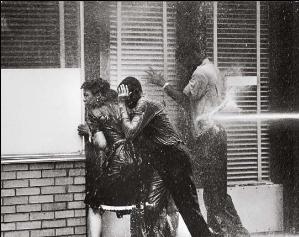
As artists seeking to help audiences achieve an Aristotelian catharsis, using the tools at our disposal -- namely, Presence and IE -- are we not engaged in the work of bringing hidden tension to the surface, so as to encourage growth and change? There was always a theatrical element to the nonviolent protest movement, and I say that in the kindest, most self-flattering sense of the word. Who could look at the images of peaceful men and women chased by dogs and blasted by firehoses for daring to sit down at the wrong lunch counter, and not think: "here is a drama, with protagonists I can identify with, with antagonists I recognize from the darkest places inside myself, and this drama is unfolding in my country, right now"? MLK made a distant idea (segregation) real and threw it in the nation's face. He made injustice Present, and a year after writing his letter stood behind Lyndon Johnson, watching him sign the Civil Rights Act.

Does all theater live up to King's ideal of a tension-revealing, boil-lancing growth engine? No. But I think, maybe, that all GOOD theater aspires to it.

And aspiration, after all, is just another word for the breath of life.

Readers, what passages stick out for you this year, from this or any other of King's work?
Read the full story

Arizona, Imaginative Empathy, and the Never Ending Story

Monday, January 10, 2011 3 comments

"What I cannot create, I do not understand."
-Richard Feynman, physicist

“Bring new light to what life might be.”
-Hugh Macleod, cartoonist

I had been thinking about writing a post like this for some time, and write it now under the shadow of the recent political murders in Arizona and Pakistan. A question J Holtham asks over on Parabasis about Giffords strikes at the heart of it:

"But...there's a difference between political speech and art, isn't there? (emphasis mine). Marilyn Manson can say, "I'm an artist, and this is a persona I use to tell a story." Can Sarah Palin or Glenn Beck hide behind the same definition? Wouldn't that discredit them entirely to say, "Hey, folks, this is all an act! I didn't mean anyone to take me seriously!"? Isn't there some level of responsibility there? If you go around saying our country is under attack, is at war, is being destroyed by our duly elected officials, sooner or later, this is what happens."

Yes, there is a difference, but I think the difference is one of degree, not of kind. All narratives - whether political, religious, or aesthetic - are an attempt to find patterns in the events of life; to reveal meaning from those patterns; and to share that meaning with others in hopes of affecting their actions. All stories ask Aristotle's question, "How are we to live?"

The evasion of art - that it is fiction, "all an act" - simply allows space for the artist to explore extremes that in political or religious narrative would be impossible. "I am the opposite of a stage magician. He gives you illusion that has the appearance of truth. I give you truth in the pleasant disguise of illusion."

Every choice I make in life is influenced by the pressure of these political, religious, and aesthetic stories; I believe in free will, but the terrain of what is possible is created by these narratives, and I move choice by choice measuring my progress against the stories I've been told.

As Slate explains about Loughner, mental illness is not enough to explain violence; you are three times more likely to be struck by lightening than killed by someone with schizophrenia. Religious fundamentalists, like Taseer's murderer, are not mentally deranged, but rather perfectly arranged by the pressures of narrative to choose violence. Their minds are gardens without a single weed.

The answer is not to censor Sarah Palin but to present a more compelling counter-narrative. The temptation is to create a narrative of similarly primal power that will have a similarly national appeal; something that feels like empathy's answer to the cross-hairs of a rifle; something like the peace movement of the 60's, with its potent symbols of flowers, children, and free love.

But I don’t think the answer lies in creating a competing narrative of national size. The history of our green and blue rock is littered with stories of peace and compassion that have been co-opted by power to sell merchandise and justify violence. We need instead to take back ownership of the stories we tell.

Those old enough to have been young enough to be scared of Gmork, the wolf agent of The Nothing in The Never Ending Story, know that whoever holds the dreams, holds the power. In the 20th century, we largely outsourced our dreams to mass media; letting radio, film, and television tell our stories for us. A monoculture of thought, just like any other ecosystem without diversity, is less resistant to viruses, invasive species, and environmental stress.

Creativity is therefore not just a right of every individual; but also a responsibility. If we tell our own story, finding our own patterns and meaning in life, then we are more resistant to the simplistic narratives of power. This creative searching is not contained by what is traditionally called “the arts”; rather, this imaginative curiosity extends to politics, religion, and any other way we have of making meaning.

The internet is a powerful ally for this creativity, resembling the sequel to The Never Ending Story, where Bastian recreates Fantasia entirely from his own imagination. But while a thousand such imaginary worlds spring up every day on the internet, it has also exacerbated the perils of monoculture; allowing simplistic narratives to metastasize more quickly.

After all, Loughner was creatively expressing himself, however violent and strange his YouTube videos seem. It is therefore not enough to imagine that if everyone just expressed themselves we’d suddenly have peace on earth. While diversity of expression is essential to the health of a culture, there is an immutable quality all good stories must share, or narrative descends into demagoguery.

That necessary quality is empathy. Empathy is not warm and fuzzy, like its cuddly cousin sympathy. Empathy is the pity and terror and joy of feeling someone else’s life as keenly as if it were your own. Empathy is frightening because it reminds us that the worst of what others do lives as a possibility within us; it reminds us that the best of who we are lives within our enemies. Empathy’s children are caution as well as kindness; humility as well as compassion.

Empathy appears to be hard wired into our brains (thanks, mirror neurons); and when followed with any integrity, it naturally leads to stories of contradiction and complexity. These kinds of stories require more from us; in creating them, in watching them, and in living with whatever difficult wisdom they contain. But these are the stories that matter - as Feynman says, “what I cannot create, I do not understand.”

Here the monoculture presses its advantage; we’re a busy people, content to have someone else assemble meaning for us, especially if the stories we’re told go down easy. There is something soothing in believing that the answers have all been found; that the book is closed, and all we need to do is follow what’s already been written. We all have a utopia habit that's hard to quit.

Imaginative empathy does not permit the book to close, because it understands that each human being represents a unique story, an unrepeatable stab at what is possible. This kind of story-telling is restless, defined by a hunger that grows by what it feeds on. It is propelled by doubt and sustained by contradiction (each one of us containing multitudes).

For these reasons, it is resistant to the simplistic narrative that violence requires. And with violent suggestion now able to metastasize into action with a single click, we must advocate more strongly for this resistant kind of story-telling. Otherwise, the virus of violence will continue to sweep through our monoculture of thought.

With theatrical storytelling, the means of production are always local; this is a financial weakness, but an essential strength. It can happen in the churches of Manhattan, it can be done in the streets of Belarus, and where ever it is done, it is a uniquely local process that belongs to those doing it. In this way, it is a remarkably effective engine of empathy against monoculture. It is the way I love best, though not the only way.

But whether you’re making a play, or singing a hymn in church, or holding high a sign at a Tea Party rally; you are engaged in telling a story, whether you call yourself an artist or not. As cartoonist High Macleod writes:

“Bring new light to what life might be.” That’s what Creativity means. That’s why you were born; that’s why you are here. To bring some new angle to the human condition- if not to the broader world in general, then at least to your family and the people around you.

I’m not so naïve to think that this local story-telling of imaginative empathy will bring peace on earth. I’m just not sure what else will.

Read the full story

, , , , ,

Ramachandran on Mirror Neurons

Wednesday, February 10, 2010 5 comments

Previously on this blog we looked at VS Ramachandran's 2007 talk on mirror neurons and phantom limbs. In that post, I imagined how the mirror effects that heals phantom limb syndrome might possibly extend to harmful emotional patterns in the mind of greater complexity, and that theatre, through its use of empathy, could heal these patterns in a similar way.

Well, in November of last year, Ramachandran upped the ante on us big time. NOW, VS says that if it wasn't for our bodies telling us constantly that we are separate creatures, there would be no difference between our experience of our own actions, and the experience of watching the actions of someone else.

Here's the video - watch it.

The ideas are revolutionary enough to need excerpting here:

"So, here again you have neurons which are enrolled in empathy. Now, the question then arises: If I simply watch another person being touched, why do I not get confused and literally feel that touch sensation merely by watching somebody being touched? I mean, I empathize with that person but I don't literally feel the touch. Well, that's because you've got receptors in your skin, touch and pain receptors, going back into your brain and saying don't worry, you're not being touched...

But if you remove the arm, you simply anesthetize my arm, so you put an injection into my arm, anesthetize the brachial plexus, so the arm is numb, and there is no sensations coming in, if I now watch you being touched, I literally feel it in my hand. In other words, you have dissolved the barrier between you and other human beings. So, I call them Gandhi neurons, or empathy neurons.

And this is not in some abstract metaphorical sense, all that's separating you from him, from the other person, is your skin. Remove the skin, you experience that person's touch in your mind. You've dissolved the barrier between you and other human beings. And this, of course is the basis of much of Eastern philosophy, And that is there is no real independent self, aloof from other human beings, inspecting the world, inspecting other people. You are in fact, connected not just via Facebook, and Internet, you're actually quite literally connected by your neurons. And there is whole chains of neurons around this room, talking to each other. And there is no real distinctiveness of your consciousness from somebody else's consciousness.

And this is not mumbo-jumbo philosophy. It emerges from our understanding of basic neuroscience."

What theatre can do is push us to the very limits of this dissolved barrier, to feel absolutely the experience of another human being as our own, while still maintaining the skin of our individuality. Read the full story

, , , , ,

Let Me Down Easy

Wednesday, December 30, 2009 3 comments

Two nights ago I saw Anna Deveare Smith's play about health care, Let Me Down Easy. I was deeply moved by the play, and haven't stopped thinking about it, as it touched on many of the ideas we've been discussing on this blog.

First, on Presence: It absolutely mattered that this was a play and not a movie. Throughout the play, Anna's characters reacted to their unseen interviewer; and at other times, the characters solicited input directly from the audience; so that subtly over the course of the play, we became the interviewer, directly participating in the action. The set design captured this brilliantly through column-like mirrors that created a reflecting ampitheatre.

Second, on Diversity: In thinking of how the audience matters, this particular night's audience was notably diverse in both race and age. And while it's stupid to assume that Audience Member X vocally responded to a particular moment simply because of their age or race, very different responses were happening all around me; and that made me notice things in the play I might have missed. Which is to say that a truly diverse audience is one of truly diverse perceptions; and that having multiple perceptions strengthens the quantum Darwinism of live theatre. I hope to come back to this as a way of exploring diversity as a uniquely theatrical need, rather than simply a general obligation.

Third, on Imaginative Empathy: One aspect of Imaginative Empathy that is particularly important to me is its power to shock us with the wonder of a single life, and makes us keenly feel the size of its loss. Anna accomplishes more than that - in the singular insight of the New Yorker review:

Smith is doing more than opening up a much needed discussion about the dying and those who minister to them. The purpose of the enterprise, we realize, is for the playwright herself to learn how to die.
And because we have been subtly led to become the interviewer, we are also learning how to die. (And who wrote those beautiful words, New Yorker? The review is unsigned!) I found myself turning over each word of the end of the play like a rough tool in my hand, as if somehow I could use them to build an edifice of comfort or courage against my end.

Fourth, on theatre as an engine of democracy: The play's great political insight is that health care is not only about public options and triggers; it is also about how we deal (or don't) with suffering and death in our culture. At the heart of the play are two interview excerpts from physician Kiersta Kurtz-Burke and Dean of Stanford's School of Medicine, Phil Puzzo. The first makes clear the cost of treating health care as a commodity; the second exposes one of the reasons our culture chooses to treat it as a commodity - an unwillingness to consider death as the inevitable end of life. Whatever your feelings on the intricacies of the health care bill, facing the human costs of health care failure in our country, and acknowledging the emotional roots of that failure, is one of the unique gifts of this play, and something theatre is uniquely able to do.

It was an inspiring evening, and even though I agree with Alexis Soloski's smart take on the play's failings, what matters about this production overwhelms the flaws. Let Me Down Easy reminds us that while the answer to life's question is death, the answer to death's question is live.

And as I am a juxtaposition junkie, I leave you with this YouTube pitch from the Manhattan Beach Project, a coalition of scientists hoping to end aging by 2029...which may or may not have an impact on the health care debate. Read the full story

,

American Homicide

Sunday, December 6, 2009 1 comments

Quite a title for a theatre blog, yes, but a new book by Randolph Roth of the same title posits a fascinating link between homicide rates and faith in government. Sifting through four centuries of history, his research points to one consistent connection: when individuals trust their government, homicide rates fall. When they don't, they rise; and Roth links this relationship to America's persistently high homicide rates. To quote:

"The predisposition to murder is rooted in feelings and beliefs people have toward government and their fellow citizens...It is these factors, which may seem impossibly remote from murder, that hold the key to understanding why the United States is so homicidal today."
Read the whole article here. What emerges is that the predisposition to murder may be linked to a narrative of social distrust. While the methodologies described in the article seem perilously open to interpretation, there is a potential takeaway for theatre makers. Those narratives of social distrust should be wrestled with in our work, increasing our mutual capacity for imaginative empathy, and creating the possibility for civic compassion.

This doesn't mean that theatre is responsible for, or capable of, lowering murder rates; nor that theatre should indulge in feel-good message plays. Quite the opposite: imaginative empathy only matters when the devil of violence is given its full due; and the necessity of civic compassion only becomes clear when opposed against its opposite. But as this blog continues to explore the conceptual case for theatre as an integral part of democracy, this seemed a good article to highlight. Read the full story

, , , , , , ,

The Transcendental Social

Tuesday, December 1, 2009 1 comments

Three interesting things regarding the brain and how we tell stories:

The Transcendental Social: A Denmark study that found that praying to God activated regions of the brain associated with talking to a friend, reinforcing a theory linking religious faith to theory of mind, the idea that our capacity to imagine the intentions and thoughts of other beings was a defining cognitive evolution. In other words, our capacity for empathy may have led directly to our capacity for faith.

This led anthropologist Maurice Bloch to coin the term Transcendental Social:

Uniquely, humans could use what Bloch calls the "transcendental social" to unify with groups, such as nations and clans, or even with imaginary groups such as the dead. The transcendental social also allows humans to follow the idealised codes of conduct associated with religion.

"What the transcendental social requires is the ability to live very largely in the imagination," Bloch writes.

"One can be a member of a transcendental group, or a nation, even though one never comes in contact with the other members of it," says Bloch. Moreover, the composition of such groups, "whether they are clans or nations, may equally include the living and the dead."

It's not a big leap to imagine how theatre connects to the ideas above: the evolutionary need to live in the imagination as a means to develop empathy and balance individual desires within a social framework lives in the practice of theatre. The Transcendental Social may be a direct result of the cognitive evolution of what Arlene Goldbard calls Imaginative Empathy, and an essential part of the relationship of democracy and theatre.

Twitter and the Global Brain: Dean Pomerleau wrote a fascinating article about how Twitter is beginning to mirror the way our brains create meaning. Basically, the way synapses develop relationships is similar to how tweeting, retweeting and following moves information through Twitter. Dean suggests ways that Twitter could mirror our brains even more, reaching a semi-autonomy that would lead to something approaching a global consciousness.

This is an imaginative world, the Transcendental Social, on an enormous scale, with information moving and relationships developing organically in real time. However, this world lacks the Presence of theatre, and it is an open question if true Imaginative Empathy is possible without presence. This may be the essential question theatre needs to ask if it is to survive in a future where connection and story are only a click away.

The Baboon Skull: Michael Finkel's article for National Geographic about the Hadza of Tanzania gives us one possible answer. The Hadza are one of the few remaining true hunter-gatherer societies left. They practice no agriculture, have few possessions, they don't have wedding ceremonies or funerals, they don't practice any codified religion, they don't celebrate birthdays; they hunt four to six hours a day, and spend the rest in relative autonomy, in stark comparison with our over scheduled lives of social obligations (the article makes clear their challenges, though, trying to avoid romantic notions of what is a difficult existence).

But they do have theatre, and it is undoubtedly a theatre of Presence. Here is an edited account of Michael's version of a story told after a successful baboon hunt - read the whole thing here:
With the baboon skull still in the fire, Onwas rises to his feet and claps his hands and begins to speak. It's a giraffe-hunting story—Onwas's favorite kind...Onwas elongates his neck and moves around on all fours when he's playing the part of the giraffe. He jumps and ducks and pantomimes shooting a bow when he's illustrating his own role. Arrows whoosh. Beasts roar. Children run to the fire and stand around, listening intently; this is their schooling. The story ends with a dead giraffe—and as a finale, a call and response.

"Am I a man?" asks Onwas, holding out his hands.

"Yes!" shouts the group. "You are a man."

"Am I a man?" asks Onwas again, louder.

"Yes!" shouts the group, their voices also louder. "You are a man!"

Onwas then reaches into the fire and pulls out the skull. He hacks it open, like a coconut, exposing the brains, which have been boiling for a good hour inside the skull. They look like ramen noodles, yellowish white, lightly steaming. He holds the skull out, and the men, including myself, surge forward and stick our fingers inside the skull and scoop up a handful of brains and slurp them down. With this, the night, at last, comes to an end.

It is always dangerous to infer too much about a different culture, particularly from a second hand account. But the article does remind me of the importance of Presence to story, how it passes on the essential meaning of experience, how often our theatre fails to thrust forward that baboon's skull, and how exciting it is when that call and response reminds us what it means to be human. Read the full story

, , , ,

Remembering, Forgetting, Theatre

Wednesday, November 25, 2009 0 comments

I want to write a little about how the scale of the way we remember and forget is changing in our culture, and what that might mean for theatre.

A few things recently caught my eye: the discovery and subsequently rapid spread of Vivian Maier's photography. Unknown as a photographer in her lifetime, John Maloof acquired her negatives at an antique auction. He discovered 30-40,000 stunning pictures, many of which had not even been developed. He has been putting her work online, and admiration for it has been rightfully spreading.

I happened upon Vivian's work via Twitter, around the same time that GeoCities and its 38 million user built pages disappeared (though efforts exist to preserve that information).

These two examples are a way of saying that because our culture can remember more deeply it can also forget more completely. We need to examine what this shift in cultural memory might mean to theatre and its role as carrier of cultural meaning. What is unique about the meaning theatre creates?

Saying a play isn't theatrical is like saying a Cabernet doesn't taste like grapes. But certain wines take advantage of the unique strengths of their terroir, and so it is worth considering what is unique in theatre's terroir. This is especially true now when our cultural meaning exists in a relentlessly evolving and expanding conversation online; when story is as common as air, and nearly as free; what essential meaning is left for theatre to carry?

Here are five aspects of theatre's terroir I've been thinking about lately:

1. Narrative Experience: This one is old as the hills, but worth remembering: theatre provides meaning that is irreducible from the experience of its story. In our current ocean of stories, this does not make it unique, however; and its cost in time and effort make this reason increasingly less persuasive.
2. Presence: Almost as old as Narrative Experience, the power of theatre "actually happening" has been held up like a talisman against film for years. Usually, it's simply stated that theatre is better because the actors can hear you, but why is that better? If a bad house decreases the quality of the playing (which happens), isn't it better to quarantine the art from outside influence?
Or, if the ability for the audience to affect the performance is important, shouldn't that make video games a more essential medium, where the audience's will is the performance? And for those who laugh at that, read this New York Times article about the next generation of video game designers who are dedicated to using what is unique about their medium to create meaningful art.
Yet any reckoning of what is unique about theatre must absolutely decide why presence is so important.
3. Four dimensions: Live performance exists in four dimensions, and while it's that third dimension that (unless you're wearing 3-D glasses) is the most noticeable difference between theatre and film, it's that fourth dimension that is most important. Film, breaking our experience of time's arrow, is the same played backwards and forwards (though perhaps harder to follow played backwards). You cannot reverse a play; the egg doesn't unbreak; the water doesn't pour itself back into the pitcher; this particular Hamlet will never speak of Ophelia's orisons in quite the same way again.
This is perhaps where Presence becomes important; the way we change the actor's performance as we both journey down the one-way street of time makes a theatrical performance significantly more like life than the two dimensional experience of film.
4. Multiple perception: In our recent interview with Rachel Cole at InDigest Magazine (not yet out), Lesser Seductions director Heather Cohn reminded me of something essential about all theatre that was especially true of our play. Theatre allows of a multiplicity of perception that is not possible (sorry, split screen) in quite the same way in film.
This is for two reasons: simultaneous action and symbolic potential. Because there is no camera to force an audience's eye, their particular journey through each moment of the play will be unique. In a play like The Lesser Seductions of History, where the characters' journeys mostly unfold at the same time, this is especially true.
Secondly, because theatre is not a literal medium (meaning that with film and video games, you are seeing the actual event, whereas with theatre, dance and the written word you are seeing a representation of an event), meaning can be created through the use of symbols. A light bulb dangling from a ceiling represents a year of the 1960's, and when lowered to the stage, becomes the circle of the moon. The light bulb has a literal meaning, and over time, accrues symbolic meaning as it is used to represent different things in The Lesser Seductions of History. And because everyone's imaginative response to these symbols will be so different, symbolic potential greatly increases multiple perception.
5. Adaptability: Theatre is a cockroach. Where film and video games need fancy equipment to exist, theatre exists anywhere there is a stage, someone walking across it, and someone watching (thank you, Mr. Brook).
Additionally, theatre adapts to the place and time where it is played, changing meaning like a chameleon blending in to fit its surroundings. The greatest plays are also the most adaptable; there is something in them that allows for so much multiplicity of meaning that they are not bound to their cultural time and place. Each group of audience and artists that plays a play shift the meaning to fit their our own unique needs of the moment, while at the same time engaging with the legacy of past productions.

SO! If you're still with me, the question remains: in a time where each evolving moment of cultural meaning exists online; and both factual and experiential knowledge are only a click away; and conversation happens across thousands of miles in real time; what does theatre have to offer?

Using the five aspects above, I think the four-dimensional narrative experience of a play, influenced by the mutual presence of artists and audience, creates a multiplicity of perception and adaptability of purpose that makes it an ideal vehicle for a particular kind of cultural meaning: the practice of human compassion.

Lofty? Not at all; poodle and chimpanzees do it. Like all social animals, they play to learn how to live together, and though we fancy ourselves infinitely more complex, the root need is the same. And because theatre remains the form of play closest to our experience of life, it remains essential.

So while I am thankful for the extraordinary powers of the internet (he says while blogging after all) to share information and foster conversation; I still believe that theatre is needed to pass on the compex cultural meaning of the practice of human compassion. Read the full story

, , , , , , ,

The Genes for Empathy and Memory

Thursday, November 19, 2009 0 comments

Two recent breakthroughs in neuroscience seemed worth reporting in the context of our work in theatre:

1. The over expression of a single gene, NR2B, caused a rat to remember things three times longer than her kin.
2. Individuals with a greater expression of a gene that regulates oxytocin score 22.7 higher on tasks that measure empathy.

Empathy and Memory: two qualities of personality central to the work we do in theatre, both linked in part to the expression of single genes, both now capable of being altered in our quest for self-improvement.

Of all the significant challenges facing theatre over the next 50 years, this is the one of the most interesting: if our capacity for empathy and memory are genetically enhanced past a certain line, will we need theatre as a cultural carrier of meaning and agent of empathy? If yes, will a new kind of enhanced theatre replace what we currently believe are masterworks of enduring beauty, reducing Shakespeare's work to drawings on cave walls?

And even if that kind of cognitive evolution doesn't happen, the moral questions regarding neuroscience need to be played out in the arena of theatre, or we will be like the playwrights of Universal Robots, handed a discovery with moral implications past our readiness.

On another note, are there plays that you've seen lately that are breakthroughs in our understanding of empathy and memory? They don't need to necessarily be directly about them, but find new ground for how we think about them. I'd like to believe that Rattlers and Pretty Theft both explored new territories of empathy: for Rattlers, how grief distorts our capacity for empathy; for Pretty Theft, how beauty does the same. And I think that The Lesser Seductions of History explores how we remember, both as individuals endlessly revising our lives, and as a culture, rewriting the meaning of the past to suit our present (in this regard, it is directly connected to Our Town and Universal Robots, two plays mentioned as kin that do the same).

One case that might be too metaphoric to make is that theatre is as much a laboratory of human behavior as the sciences, and as such, deserves funding for research that may lead to both dead ends and breakthroughs. But for that to be true, we would need to have some actual breakthroughs in how our theatre explores human consciousness - what have you seen that's breaking this kind of new ground? Read the full story

, , , ,

Arlene Goldbard on Imaginative Empathy

Wednesday, August 5, 2009 0 comments

I had meant to post a link to Arlene Goldbard's talk at the NET Summit in San Francisco some time ago, but time keeps on slipping, slipping. However, now is still as good a time as any, maybe more so after posting Ellen McLaughlin's commencement address on the twin births of theatre and democracy.

Both are concerned with art's role in civic life, and both engage with that concern by widening the possible/necessary in exciting ways. Read together, they offer one compelling answer to the question of value I raised here.

Here is an excerpt from the talk to tempt you into going to her website and downloading the whole thing:


"Now it’s up to us to apply this knowledge to the problem of national recovery and the challenge of building a humane, sustainable civil society right here in the United States. Now is the time for a radical re-understanding of the social role, the critical importance, the public interest in creativity, specifically artistic creativity. We can close the gap in understanding that has prevented so many people from seeing that artistic and cultural creativity is not just a nice thing to have around, and a really special amenity when you have the resources to invest in something extra, but a necessity for recovery, survival and sustainability.

How do we do that? We have to begin by enlarging our own thinking, speech and action. I estimate that I have been in about a trillion conversations, read about a billion arguments, that end in the slogan, “support the arts.” Accustomed to long-term deprivation, conventional arts advocates tend to think small, focusing on saving the tiniest government agencies, on hoping not to lose too much more this time around. Many conventional arts-support arguments are silly; for example, the “economic multiplier effect” of buying theater tickets: people who go to the theater may eat in a restaurant or pay to park their cars, they may have a drink after the performance. Each additional expenditure multiplies the economic impact of a dollar spent on tickets. That’s the economic multiplier effect, and, yes, it all adds up to jobs. But so what? Going to a dog show or a football game or lady mud wrestling has the same economic impact. And that’s one of the strongest conventional arts-support arguments! After decades of this stuff, conventional arts advocates have worn themselves thin stretching a point, with almost nothing to show for it. Adjusted for inflation, even the recently expanded 2009 NEA budget is worth only a bit more than half its value in 1981, the year of Ronald Reagan’s first budget cuts.

In a time of economic crisis, when people are worried about surviving, when it is hard to fund schools, housing and medical care (but still not so hard to finance war, unfortunately), arts support arguments become even more half-hearted and desperate, and therefore even less effective. You don’t need me to tell you what’s happening to your own organizations and your own communities right now. I am reminded of the dream of right-wing crackpot Grover Norquist, who said, “I don’t want to abolish government. I simply want to reduce it to the size where I can drag it into the bathroom and drown it in the bathtub.” That is what has happened over the last three decades to the arguments for arts support, which are circling the drain as I speak.

The remedy isn’t more shrinkage but the opposite, to think big. Conventional arts advocates claim art enriches, beautifies, expresses and entertains. These are important social goods. But the elephant in the room right now, the large, unacknowledged truth that we had better hurry up and shout from the rooftops, is that in a uniquely powerful way, art can save us.

Does the grandiosity of that assertion make you uneasy? Just give me another ten minutes before you make up your mind whether to listen to your uneasiness or to your hopes."
Read all of it here - and it's worth the read. Read the full story