
Theatricality
Friday, August 26, 2011
0
comments
Isaiah here with yet another overly-long, thoughtful-to-the-point-of-pedantry post.
So, over at HowIRound there's a very interesting piece by Lydia Stryk about this "theatricality" thing. You should definitely read the whole thing (and the comments, and the response at Parabasis, and the comments there), but here's the money quote if you're pressed for time:
Theatricality in America today, I would argue, is an MFA-inspired phenomenon produced almost solely by playwrights and duly supported by directors. The resulting highly theatrical plays teeter on the edge of magical realism or plummet over the top with plot elements and stage directions that seem derived from a handbook on wizardry. It’s worth noting that this new theatricality is woven into the plot, making it impossible to ignore in the way the old stage directions (She stands, he sits) were and are ignored.The implication here is that "stage directions that are woven into the plot," particularly whimsical ones, are (a) something unique to recent American theater, and, because they cannot be ignored, (b) bad.
In a comment on the original post, Taylor Mac has already made a case that realism is actually the recent trend, so I want to respond to the second implication. I want to ask this: what's wrong with stage directions out of a wizard's handbook? Yes, they can be used lazily. Yes, they can be spectacle. Yes, they feel contrived or out of place or distancing. When they do these things -- and I won't lie, they often do -- they fall on their face.
But they aren't necessarily so.
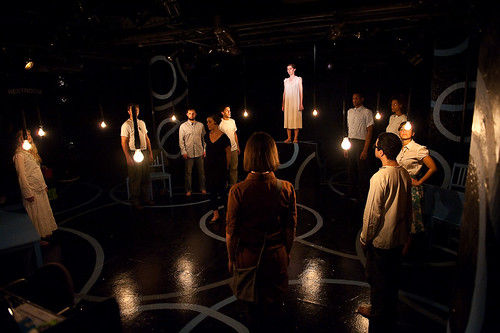
The image I used above is the last moment of The Lesser Seductions of History, Flux's most well-received show, and I believe its greatest artistic triumph (so far!). A brief overview: the play was set in the 60's, and each scene was a different year. With each new year, one of the 10 characters makes a choice between a life of personal fulfillment and a life devoted to a greater cause. Those 10 lightbulbs were in the ceiling the whole time, a new one lighting up as each character made that choice and a new year dawned. Then, in the final scene, they descended as eight of the characters, each for deeply personal reasons, danced, then slowly became the astronauts on the moon, before finally forming a circle looking in at the eleventh character, One, who is the force of History that "seduced" them (hence the title) and in her final monologue asks, "wasn't it worth it?"
The lightbulbs were the years, and the characters, and the choices, and the stars, and pretty, all at the same time. This is just the sort of thing that Lydia doesn't like. It's wizardy, and it's weird, and it's whimsical. It was also profoundly moving, BECAUSE it was those things, not in spite of them. That moment wouldn't have worked, or would have worked in a profoundly different and (I believe) less successful way, without those lightbulbs, or some other director-picked design element that ostensibly served the same purpose.
Flux has talked a lot about what we mean by "Transformative Theatre" (sometimes we've even used other words for it); it's so central to what we do that it's in our mission statement as well as our list of aesthetic values. One of several things you can't do in a film, but you can do on a stage -- and therefore seems like the best definition of a term ("theatricality") whose definition few can even agree on -- is make something be two or more things at the same time. In the film version of Lesser Seductions, if you wanted to see the moon landing you'd show the footage. You'd probably cross-cut that with the characters, and others around the world, watching it at home (that's what the very powerful HBO documentary From the Earth to the Moon did). Which works great for film.
But there's something amazing, and powerful, and theatrical about seeing the other actors, who you've spent the last two hours with, dance around the stage as though on the moon, and it spoke to the central idea of that moment: that on July 20, 1969, it was as though everyone in the world, no matter what they were doing, was bouncing about the lunar surface with Neil and Buzz. I've got to say, I'm just thinking about it and I'm still moved by the memory of creating that poetic moment on stage. And I wasn't even alive in 1969.
I guess what I'm saying is that there are plenty of highly theatrical moments out there that you can effectively create with a whimsical stage direction or two. Lydia talks about the process by which she arrived at her theatrical stage directions -- essentially shoehorning them into her play to make it more marketable -- and I agree that this is a lousy way to create art that you're proud of, and it's almost guaranteed to leave a bad taste in your mouth for the whole process, and make seeing other such attempts that much more grating. But I'd encourage her not to throw the theatricality baby out with the marketability bathwater.
Read the full story


 Posts
Posts


