Showing posts with label Aesthetic Values. Show all posts
, , , , , , ,

Theatricality

Friday, August 26, 2011 0 comments
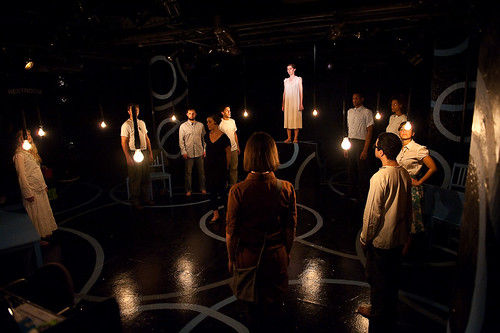

Isaiah here with yet another overly-long, thoughtful-to-the-point-of-pedantry post.

So, over at HowIRound there's a very interesting piece by Lydia Stryk about this "theatricality" thing. You should definitely read the whole thing (and the comments, and the response at Parabasis, and the comments there), but here's the money quote if you're pressed for time:

Theatricality in America today, I would argue, is an MFA-inspired phenomenon produced almost solely by playwrights and duly supported by directors. The resulting highly theatrical plays teeter on the edge of magical realism or plummet over the top with plot elements and stage directions that seem derived from a handbook on wizardry. It’s worth noting that this new theatricality is woven into the plot, making it impossible to ignore in the way the old stage directions (She stands, he sits) were and are ignored.
The implication here is that "stage directions that are woven into the plot," particularly whimsical ones, are (a) something unique to recent American theater, and, because they cannot be ignored, (b) bad.

In a comment on the original post, Taylor Mac has already made a case that realism is actually the recent trend, so I want to respond to the second implication. I want to ask this: what's wrong with stage directions out of a wizard's handbook? Yes, they can be used lazily. Yes, they can be spectacle. Yes, they feel contrived or out of place or distancing. When they do these things -- and I won't lie, they often do -- they fall on their face.

But they aren't necessarily so.

The image I used above is the last moment of The Lesser Seductions of History, Flux's most well-received show, and I believe its greatest artistic triumph (so far!). A brief overview: the play was set in the 60's, and each scene was a different year. With each new year, one of the 10 characters makes a choice between a life of personal fulfillment and a life devoted to a greater cause. Those 10 lightbulbs were in the ceiling the whole time, a new one lighting up as each character made that choice and a new year dawned. Then, in the final scene, they descended as eight of the characters, each for deeply personal reasons, danced, then slowly became the astronauts on the moon, before finally forming a circle looking in at the eleventh character, One, who is the force of History that "seduced" them (hence the title) and in her final monologue asks, "wasn't it worth it?"

The lightbulbs were the years, and the characters, and the choices, and the stars, and pretty, all at the same time. This is just the sort of thing that Lydia doesn't like. It's wizardy, and it's weird, and it's whimsical. It was also profoundly moving, BECAUSE it was those things, not in spite of them. That moment wouldn't have worked, or would have worked in a profoundly different and (I believe) less successful way, without those lightbulbs, or some other director-picked design element that ostensibly served the same purpose.

Flux has talked a lot about what we mean by "Transformative Theatre" (sometimes we've even used other words for it); it's so central to what we do that it's in our mission statement as well as our list of aesthetic values. One of several things you can't do in a film, but you can do on a stage -- and therefore seems like the best definition of a term ("theatricality") whose definition few can even agree on -- is make something be two or more things at the same time. In the film version of Lesser Seductions, if you wanted to see the moon landing you'd show the footage. You'd probably cross-cut that with the characters, and others around the world, watching it at home (that's what the very powerful HBO documentary From the Earth to the Moon did). Which works great for film.

But there's something amazing, and powerful, and theatrical about seeing the other actors, who you've spent the last two hours with, dance around the stage as though on the moon, and it spoke to the central idea of that moment: that on July 20, 1969, it was as though everyone in the world, no matter what they were doing, was bouncing about the lunar surface with Neil and Buzz. I've got to say, I'm just thinking about it and I'm still moved by the memory of creating that poetic moment on stage. And I wasn't even alive in 1969.

I guess what I'm saying is that there are plenty of highly theatrical moments out there that you can effectively create with a whimsical stage direction or two. Lydia talks about the process by which she arrived at her theatrical stage directions -- essentially shoehorning them into her play to make it more marketable -- and I agree that this is a lousy way to create art that you're proud of, and it's almost guaranteed to leave a bad taste in your mouth for the whole process, and make seeing other such attempts that much more grating. But I'd encourage her not to throw the theatricality baby out with the marketability bathwater.
Read the full story

, , , , ,

Friends of Flux

Thursday, November 18, 2010 2 comments

This post continues on our updates on the changes that came out of our Annual Retreat - past posts have focused on Core Values, Aesthetic Values, and Membership Structure.

As mentioned in our previous post on Membership, moving away from the two-tiered Membership structure necessitated the creation of a second relationship circle. We wanted to honor the people closest to Flux who weren't right for formal Membership, and so created a special relationship category called Friends of Flux.

Friends of Flux, or 'FOFs', are the artists and audience members who have shown a sustained commitment to Flux through some combination of time, resources and talent. FOFs have supported our work through artistic collaboration, committed show attendance, production support, and financial contributions; and we want to honor and celebrate that ongoing relationship.

What exactly are FOFs? We're still in the process of figuring that out, but we know what FOFs and Flux should be for each other:

Ambassadors:

  • Flux and FOFs will use social media and word of mouth to spread the news about each other's work, including posting links to each other on our mutual websites
  • FOFs have direct access to suggest the work of worthy theatre artists to Flux, and Flux will give those suggestions priority consideration for Flux Sunday and other artistic opportunities
Accomplices:
  • FOFS will look for opportunities to support Flux's mission through volunteering when available
  • Flux will pass on opportunities to FOFs, looking to move forward each others work when possible
Allies:
  • Flux hopes to create a special social media group for FOFs, possibly called FluxBook. This will allow FOFs to communicate directly, providing FOF-specific opportunities to each other, and building an even stronger community
  • Flux will look for other opportunities for increased access, including insider emails and monthly town halls, called SpeakEasy, where FOFs and Membership share ideas over drinks post Flux Sundays
  • FOFs will have increased access to Flux process, through priority invites to special events and the rehearsal process
  • FOFs will participate in a poll for season decisions, giving everyone a voice; Flux will respond to directly to the ideas generated by such discussions
Artists:
  • FOFs will have increased access to artistic opportunities - special callbacks for actors, streamlined director proposals, priority script consideration. Non-theatre artist FOFs will have other ways to engage creatively with the community
  • Flux and FOFs will actively look for chances to work together, prioritizing such collaborations
Audience:
  • Flux will provide priority discount tickets to FOFs when available
  • FOFs will actively recruit new audience members and potential FOFs, and receive discount tix and special events to help do so
Awesome!
  • We want FOFdom to be fun! Silly titles, FOF happy hours, FOF SWAG, whatever is fun and Fluxy
This give and take was in large part already happening, but we wanted to make this kind of relationship official as a means of empowering FOFs to engage more deeply with Flux, and for Membership to better serve our FOFs. We like it, and so, we want to put a ring on it.

Friend of Flux status is re-evaluated every year to make sure both sides are getting something meaningful out of the relationship. We'll shortly be posting a list of our inaugural Friends of Flux - it's a pretty amazing group of audience and artists, and we're extremely fortunate to have them as the foundation of our mission to build a creative home.

If Friends of Flux sounds like something you'd like to be a part of, just ask a Member; we're trying to strike the balance between small enough to matter but big enough to count; and we want to make sure that everyone who works with us, FOF or not, feels valued and respected as per all those newly minted Core Values of ours. FOFdom is a work in progress, but we're excited to see where it goes. Read the full story

, , , ,

Membership

This post continues on our updates on the changes that came out of our Annual Retreat - past posts have focused on Core Values and Aesthetic Values.

A change in Flux's Membership structure has been in effect on the ground for some time now, and we thought it was time to tell you about it. Some of you may be curious about the inner mechanics of Flux; other structure junkies may find this change interesting in its move away from organizational rigidity towards a flexibility based on mutual trust.

Those paying close attention may have been familiar with our past two-tiered Membership structure of Core Members and Members. We decided that we would move away from that two-tiered structure into a single Membership category. There will be no more Core Members of Flux. Instead, there will simply be Members, all of whom have the same level of rights and responsibilities. Membership is now seen as an Artistic Partnership. All Members of Flux are committed to an Artistic Partnership with each other. (To clarify, Members will still be called Members - Artistic Partnership is capitalized here as the central definition of Membership for emphasis, but we are not changing our titles to Artistic Partners).

What does this Artistic Partnership look like?

  • It is committed - all Members are doing a similar amount of work.It is based on equality - there will be a single voting process that treats all Membership votes equally. Department Directors will retain control over the day to day functioning of their departments.
  • It is built on belief in each other - the season discussion includes a frank conversation about the artistic needs of each Member. There is no system of artistic guarantees, rather an open conversation about how each Member will fit into a current season. Because Membership is an Artistic Partnership, this conversation will naturally lead to artistic opportunities for Members, because we will want to create those opportunities for each other. This discussion of artistic opportunities balances the needs of individual artists with the overall good of the Ensemble, with Members expected to be mature contributors to that discussion.
  • It is maintained by trust - rather than an overly complex laundry list of responsibilities, Members are expected to be self-starting catalysts who don't need to be told what to do, or always checked up on to make sure they're completing work. An Artistic Partner is someone who looks for every opportunity to move the Ensemble forward.
  • It is long term - as Artistic Partners, we are committed to each other, and the Ensemble, for the long haul.

The primary rights of Membership are voting rights. All Members vote in all major decisions the Ensemble makes. The current decisions that require a Membership vote are as follows:

Votes that belong to all members:
  • Season selection of plays (major majority)
  • Season theme (majority)
  • Director selection for full production (major majority)
  • Budget (majority)
  • Performance space (majority)
  • Performance schedule/calendar (majority)
  • New Members and Removing Members (unanimous)
  • Friends Of Flux (majority)
  • Changing the working agreement/amendments - mission, core & aesthetic values (major majority)
  • Retreat invites – voting structure (unique)
  • Adding or subtracting programming (major majority)
The primary responsibilities of Membership are unique to each Member, with the expectation that each Member will be contributing a similar amount of effort. However, some responsibilities exist for all Members, including:

Responsibilities that belong to all members:
  • Taking a daily leadership role in the governance of Flux
  • Making significant artistic contributions
  • Contributing to the execution of every aspect of production
  • Showing up for load-in, tech, front of a house, and strike; and providing pre-tech production assistance
  • Attending Flux meetings regularly
  • Showing financial stewardship by helping fundraising efforts
  • Being an ambassador for Flux
Why this change? Because the division between Core and Regular Members, with their differing levels of rights and responsibilities, was simply unsustainable. We learned after a lot of trial and error that at the leadership level of our Ensemble, we needed an equality of rights and responsibilities. But this change required the creation of a new circle of engagement for people making significant contributions to Flux that for whatever reason were not able or willing to commit to the structure of Artistic Partnership outlined above.

That circle became Friends of Flux, and it will be the subject of our very next post. If there are any other Ensemble companies reading this post, I'd love to hear how your org structure matured over time, and what you learned along the way. Read the full story

, , ,

Mission Statement

Friday, October 15, 2010 0 comments

(Photo by Heather Cohn from the Flux Retreat)

Mission Statement: Flux Theatre Ensemble produces transformative theatre that explores and awakens the capacity for change. As an ensemble-artist driven company, we believe that long-term collaboration and rigorous creative development can unite artists and audiences to build a creative home in New York.

Believe it or not, that mission statement is the result of four years of battling over the meaning of every single word. That journey wasn't easy in part because of my feeling that a mission statement was somehow antithetical to the creation of art, like pinning butterflies to the wall; and our mutual fear in crafting one of the interchangeably generic mush statements that abound.

But gradually, others in Flux made compelling cases for how a mission could prove useful, and we lurched fitfully towards carving one out. At our annual retreat, we finally hammered it out. What follows is an unpacking of our mission statement, with an eye towards both its conceptual history and practical application.
(Photo: Heather Cohn. Pictured at some late night retreat gaming, Kelly O'Donnell, August Schulenburg and Isaiah Tanenbaum)

Flux Theatre Ensemble: That's us.

Produces: We used this word as opposed to creates because some of the work we do comes from outside the development process outlined in the second sentence; and our identity as artist-producers is important to us.

Transformative theatre: What on earth does this mean? We've long valued this expression without being able to quite define it. Our recently posted aesthetic values will give you a sense of what it means to us on the stage; we value the capacity for change in every element of production. This means characters who either enact great change in the world of the play or are themselves significantly transformed; themes which compound layers of meaning as the action builds; worlds that live on the edge of some fundamental shift; contrasting aesthetic styles in a single play that, juxtaposed, create some new way of playing; staging that celebrates the transformative power of the audience's imagination; and above all, a charged ambiguity of meaning that lives in the audience's body and mind long after the play ends.

That explores and awakens: The plays we do not only stake out new territory in the evolutions of the human spirit, but awaken the capacity for that evolution in our audience.

The capacity for change: The patterns of narrative that give human life meaning must constantly be challenged and expanded by the communal, creative act of art; doing so allows new, more vital narrative patterns to emerge, increasing our mutual capacity for life. That may sound lofty, but it is entirely practical; the plays we do must wrestle with some new way of seeing; they must create the possibility of some new pattern of meaning. It's important to note that doesn't mean a traditionally avant-garde style; we do not seek to take simple things and make them seem complex; rather we hope to take complex things and tell them as simply and directly as possible.
(Photo: Heather Cohn. Pictured at the retreat's closing circle - Ken Glickfeld, Jane Lincoln Taylor, Cat Adler-Josem)

As an ensemble-artist driven company: This sentence has a blood-soaked pedigree! The battle between driven and led, the long journey to hold many values in those three words, "ensemble-artist driven", could hold a stage or two in terms of drama. We are artist driven, and so all decisions come out of the forward propulsion of our ensemble's creative interests. All administrative and producing decisions are driven by that creative propulsion; we are not an institution that exists to perpetuate an institution. However, driven rather than led allows the possibility of one day taking on administrators who are not directly participating in the creative work, provided the balance always tilts towards the ensemble-artists' leadership.

We believe that long term collaboration: Flux is not into one night stands! We hope that every artistic and audience relationship will develop into a long term relationship, allowing for the fact this won't always be so. Not only do we believe that a higher quality of work is possible when artists commit to a long term collaboration, but we believe that holds true for the audience, as well. Theatre is not a product to be made by temporary workers and sold to strangers, but an ongoing communal process between artists and audience. To that end, we are establishing a relationship category, Friends of Flux (hereafter FOFs), that puts audience, donors, and artists on equal collaborative footing, and places value on the sustained commitment of time, talent and resources between Membership and this community. More details on this anon!

And rigorous creative development: A company is defined as much by what they do as what they say, and one thing Flux does a LOT of is creative development. Through our weekly workshop Flux Sundays, through our more in depth processes of Have Another and Food:Soul, through our communal theme-wrestling of ForePlay, through our annual retreat and through the independent development process that many of our full productions go through; Flux develops not only new plays but artists, and the relationship between artists, and the relationship between the work, artists, and audience. We are developing a creative community, and that community is developing a creative process, and that process leads to new work.
(Photo: Heather Cohn. Pictured: Retreaters engaging in some after hours creative development)

Can unite artists and audiences: As you can see from the past two definitions, redefining the relationship between our artists and audience is very important to Flux. Our audience drinks with us at Have Another, eats with us at Food:Soul; responds to the work in person and online; and in a new bit of programming, SpeakEasy (stay tuned for more info on that), engages with us directly in the governance of the Ensemble. The goal is to create a more sustained, meaningful relationship between these normally divided partners in making theatre, to help them feel responsible to and for each other.

To build a creative home: One of the defining challenges of the field is the feeling of homelessness of artists in their relationship to institutions; and for the institutions, losing the subscriber base that made their theatre a home. Creating this home for both artists and audience is the ultimate mission of Flux; believing a vibrant artistic home united in exploring our capacity for change will lead to both more empowered individuals and interconnected community.

In New York: Cause that's where we live.
(Photo: Heather Cohn. Pictured: Christina Shipp, Matthew Archambault, Marnie Schulenburg)

As we go forward here on the blog, I'll be trying more often to link the discourse here to the mission, core values, and aesthetic values as a means of clarifying their practical definition and sounding the Fluxy-ness of the things we do. Read the full story

,

Aesthetic Values

Tuesday, September 14, 2010 0 comments

(Photo: Tiffany Clementi. Pictured: Adam Szymkowicz, Kelly O'Donnell, August Schulenburg, working on Adam's play CLOWN BAR)

After establishing our Core Values at the 5th annual retreat, we moved onto Aesthetic Values. There was plenty of discussion surrounding these values as well; including whether or not we even needed them.

After all, we're artist-driven, and good artists often shed aesthetics as they evolve from one project to the next. Worse, aesthetics can often devolve into generalizations where every theatre sounds like the other; or can become so specific they stifle creative exploration.

But it is helpful - when discussing potential plays for the season, or communicating our work to outside artists, or evaluating our work internally - to have some common aesthetic language. We therefore attempted to parse our creative DNA; the building blocks that make up the wildly diverse kinds of work we do. We've always felt drawn to the words "transformative theatre", and they have ended up in our mission statement; but what exactly does that mean?

AESTHETIC VALUES
Flux’s aesthetic is ensemble-artist driven and evolves according to the needs of our community.

Character-Driven: Our plays are illuminated by human choices, by how people change, and through the conflict and consequences of their actions.

Structural Complexity: Our plays contain layered worlds, multiple stories and shifting perspectives that cohere into a dynamic whole.

Juxtaposition: Our plays embrace collisions of different tones, styles and genres - often within a single moment.

Transformative Staging: Our plays take a single element (e.g. an actor, prop, set piece) and use it in multiple ways, trusting the rough magic of theatre and the audience’s imagination to build layers of meaning.

Moral Ambiguity: Our plays allow contradictory forces equal presence and challenge conventional notions of absolute right.

Audience Intimacy: Our plays seek the most direct route to share the experience of the characters with the audience to inspire collective catharsis.

As with Core Values, these Aesthetic Values emerged from a long and winding process. We began in 2008 by identifying key moments of heat in our production history.

We then grouped these moments into clusters, pairing them with other moments that seemed to share something essential. These clusters were then grouped again into larger categories.

In 2009, we attempted to define these categories, and that work continued into 2010. This allowed us to move quickly at the retreat to put the final touches on the values above.

Ideally, these values will serve as a way of talking about the work, and if we diverge from the values above, we do so knowingly. The values should serve as inspiration more than definition; direction rather than destination.

What do you think? Would you want to see the kind of theatre described above? If you have a company, have you defined Aesthetic Values; and if so, what advice do you have to share? Read the full story