 (Lysander: Jake Alexander, Hermia: Amy Fits, Demetrius: Brian Pracht, Helena: Candice Holdorf, Photo: Isaiah Tanenbaum)
One of the most stunning misconceptions of Midsummer is the idea that the lovers are indistinguishable from each other, when from the first lines they speak to the last, they could not be more different. Even under the spell of Love-In-Idleness, they manifest its power differently. And all four lovers undergo a different tear, and a unique mending.
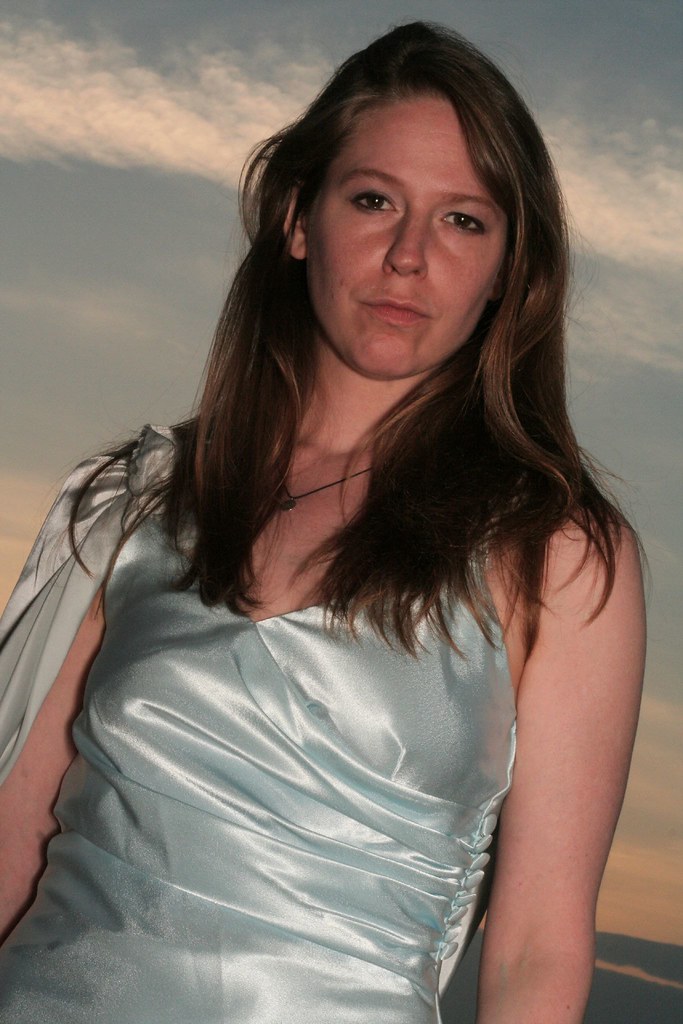
 (Hermia: Amy Fitts, Photo: Isaiah Tanenbaum)
Hermia, from the very first moment she speaks, shows real courage:
I know not by what power I am made bold,
Nor how it may concern my modesty
In such a presence here to plead my thoughts:
But I beseech your Grace, that I may know
The worst that may befall me in this case,
If I refuse to wed Demetrius.She speaks this to Theseus, slayer of the minotaur and uniter/dictator of Athens, a dangerous man who has more important things to do than solve Egeus' domestic dispute. Furthermore, she is directly contradicting her father here, who has already told her what may befall her should she refuse to wed Demetrius - death. And amazingly, her gamble works, and Theseus mitigates the sentence to a nunnery. Perhaps Theseus sees a little of himself in her courage?
Her character deepens in the following scene with Lysander, where while intending to comfort her, Lysander surprises himself by discovering that no love can survive in this world; it is only a brief dream of heaven and earth before the jaws of darkness do devour it up. It is Hermia who rallies with him with this:
If then true lovers have been ever cross'd,
It stands as an edict in destiny:
Then let us teach our trial patience,
Because it is a customary cross,
As due to love as thoughts, and dreams, and sighs,
Wishes and tears; poor Fancy's followers.
The way she handles this adversity inspires Lysander to take huge risk - to run from the Athenian law and seek refuge miles away with his aunt, where they can be married. But Hermia does not say yes to this rash and dangerous proposal right away; rather, she thinks through the risk and gathers courage and says in one of my favorite Hermia passages:
And by that fire which burned the Carthage Queen,
When the false Troyan under sail was seen,
By all the vows that ever men have broke,
(In number more than ever women spoke)
In that same place thou hast appointed me,
Tomorrow truly will I meet with thee.
The Carthage Queen is Dido, who immolated herself when Aeneas betrayed her; and it is fascinating to me that in the moment of accepting this dangerous proposition, Hermia remembers a woman who burned to death for a betrayed vow of love; and swears by all such broken vows; and by doing so, accepts the danger knowing full well it could end in her own death, her own betrayal.
How can we not admire a woman who so bravely and knowingly risks everything for not only love, but the right of her own free will? and yet...and yet...
Before the time I did Lysander see,
Seem'd Athens as a Paradise to me:
O then, what graces in my love do dwell,
That he hath turn'd a heaven into hell.
This moment of realization, shared with her friend Helena in the moment of their parting, reveals that Hermia, while accepting the loss of exile, feels that loss keenly. This is not some romantic happy adventure, but the only option in a difficult world. And it is this moment of dark realization (that Lysander tries to smooth over with his poetry) that informs the next time we see Hermia, where she and Lysander are lost in the wood, and she refuses to lie next to him:
Nay good Lysander, for my sake my dear,
Lie further off yet, do not lie so near.
Now a new side of Hermia is revealed: she can be as cautious and brave; as traditional as she is daring; and some of this refusal must be in part connected with "what graces in my love do dwell, that he hath turned a heaven into a hell"; and not only that, but he has lost their way.
This fight (for it is a fight, however cleverly disguised in pretty riddling) results in the nightmare of Hermia being abandoned, like the Carthage Queen. When she wakes to find Lysander missing, how can she not in part believe he left because she refused to lie next to him? No wonder she is so eager to pin the blame on Demetrius, who may not be perfect but who is certainly not a cold blooded murderer.
For thou (I fear) hast given me cause to curse,
If thou hast slain Lysander in his sleep,
Being o'er shoes in blood, plunge in the deep, and kill me too:
The sun was not so true unto the day
As he to me.
Would he have stolen away
From sleeping Hermia?
I'll believe as soon
This whole earth may be bored, and that the Moon
May through the Centre creep, and so displease
Her brother's noontide, with th'Antipodes.
It cannot be but thou hast murder'd him,
So should a murderer look, so dead, so grim.
The Folio gives such a useful cue here, setting the question on its own line, because of course a part of her does believe it - Hermia's fear of abandonment is a constant throughout the play, hovering ghost like above and beneath all her lines. And our brave and cautious Hermia is now so transformed by that fear (and the fear Lysander may be dead) that she is "past the bounds of maiden's patience", and scares Demetrius from following her.
That maiden's patience will undergo a further explosion when her best friend Helena is revealed as the culprit of Lysander's disappearance. Though to us it is funny, there is nothing funny about your best friend sleeping with your love the very night you have refused to sleep with him. The levels of betrayal and regret are very strong:
You thief of love; what, have you come by night
And stolen my love's heart from him?
Shakespeare is always a master of revealing the infinite highs and lows of character, suddenly, like a top blowing off or a bottom dropping out. And here, in this moment, the bottom drops out for Hermia; and she tries to violently scratch out her best friends eyes. That she is thankfully unsuccessful keeps the scene funny; but the intent is not at all funny. We can only wonder what would happen if she really did get her hands on Helena in that moment. And we wonder how our brave and cautious, wise and resourceful Hermia has would up howling like a wounded animal and trying to scar her best friend's face.
But as she falls under Puck's sleeping spell, the last words she utters are:
Heavens shield Lysander, if they mean a fray.
In the moment of maximum confusion, fear, and loss; she is not thinking of herself, but the one she loves, the false Troyan who has betrayed her. And when she wakes, she will look at Lysander and say this:
Me-thinks I see these things with parted eye,
When every things seems double.
She sees Lysander, both as the adder of her dream, and the good man who loves her again. And one of the great mysteries of this play is how Shakespeare could create two such women as Hermia and Helena, and then give them nothing to say in the final act. After Hippolyta and Theseus, Hermia and Egeus are the next characters to experience the tearing action of the play, and though she is mended; it is an uncertain mending, and not one without loss and change.
 (Helena: Candice Holdorf, Photo: Isaiah Tanenbaum)
Helena has the most text of any of the lovers (and the third most in the play), and of all the lovers, seems to spark Shakespeare's imagination the most. Every thought Helena has is twisted by her relentless imagination until every last drop of thought and feeling is wrung from it; her thoughts chase their own tail; endlessly qualifying and attempting to rewrite the unbearable fact of her love for Demetrius, and his betrayal of their betrothal. Listen to her thoughts pacing back and forth, trying to defang the pangs of her feelings:
Things base and vile, folding no quantity,
Love can transpose to form and dignity,
Love looks not with the eyes, but with the mind
And therefore is wing'd Cupid painted blind.
Nor hath love's mind of any judgment taste:
Wings and no eyes, figure, unheedy haste:
And therefore is Love said to be a child,
Because in choice he is so oft beguil'd,
As waggish boys in game themselves forswear;
So the boy Love is perjured every where.
It is almost as if by saying what love is, by what love is exactly, she can diagnose the illness and then propose a cure:
And I am sick when I look not on you.
She is trying to give to airy nothing (love) a local habitation and a name; but our lunatic/lover/madwoman fails to purge herself. However, while her imagination cannot defeat the love within herself, it is endlessly resourceful against Demetrius, and in their debate in the woods, there is no reason he can give to make her leave that she can't turn into a reason she should stay; perhaps most beautifully given proof when he reprimands her with:
You do impeach your modesty too much,
To leave the City, and commit your self
Into the hands of one that loves you not,
To trust the opportunity of night,
And the ill counsel of a desert place,
With the rich worth of your virginity.
And she responds with:
Your virtue is my privilege: for that
It is not night when I do see your face.
Therefore I think I am not in the night,
Nor doth this wood lack worlds of company,
For you in my respect are all the world.
Demetrius is no match for a mind that can make her worst faults his best virtues. Throughout the scene, she spins his straw into gold. And through this scene, we become aware that one of the reasons he has fallen out of love with her, and in love with the unavailable Hermia, is that Helena loves him not wisely but too well; she sees him for the good man he is even in his absolute worst moments; and that knowledge, that deep intimacy, is part of what sickens Demetrius.
But more on him anon. After Helena is finally outrun by Demetrius, she utters this terrible line:
No, no, I am as ugly as a Bear
And as she again compares herself to Hermia, we see that this goes deeper than just Demetrius' betrayal; it is also the betrayal of Hermia leaving their friendship for Lysander; and deeper still, a fundamental belief in her own unworthiness; and it must be partly that belief that makes the way she loves Demetrius drive him to Hermia. Because when Lysander professes his love for her, her first reaction is:
Wherefore was I to this keen mockery born?
Why should she assume that Lysander is mocking her? And when Demetrius begins to praise her, why shouldn't she believe that he has returned to loving her again (they are, after all, betrothed to her). And why, when her best friend Hermia enters, does she so quickly believe that Hermia has not only conspired with the men, but possibly contrived the whole game?
And then, one of the strangest passages in this very strange play pours out of Helena's mouth to Hermia:
We, Hermia, like two Artificial gods,
Have with our needles, created both one flower,
Both on one sampler, sitting on one cushion
Both warbling of one song, both in one key;As if our hands, our sides, voices and minds,Had been incorporate. So we grow together,
Like to a double cherry, seeming parted,
But yet a union in partition,
Two lovely berries molded on one stem,
So, with two seeming bodies, but one heart,
Two of the first life coats in heraldry,
Due but to one and crowned with one crest.
Why does Helena (and for that matter, Shakespeare) in the heart of the confusion and at the very moment when we want the machine of the plot to kick all the way in; why this reverie of their childhood? The playable answer is Helena wants to remind Hermia of their friendship so she will stop the confederacy of the game; but another answer must be in this moment of confusion, all of it caused by love, Helena remembers the time when a different kind of love presided over their lives; not one of jealousy, lust and betrayal; but one of absolute innocence and union. It is hard to imagine this kind of union ever existing between the romantic couples. And in this play of rips and mending, this image of the two girls sewing themselves a world unto themselves takes on great power; as a reminder of what is lost when romantic love becomes our be-all and end-all.
We also see that this is the way Helena loves both friend and lover; with an absolute devotion and need for the kind of intimacy that erases the boundaries between souls. Contrast this with Hermia, who when Lysander speaks of their sharing one heart, asks him to lie further away from her. Of all the lovers, Helena comes closest to needing the kind of union that Bottom experiences with Titania, where the self disappears completely into the beloved and all mortal grossness is purged.
Will she find that with Demetrius?
And I have found Demetrius, like a jewel,
Mine own, and not mine own.
I don't know. Much of the answer to that lies in the great riddle of Demetrius.
Read the full story

 (Photo: Shalin Scupham, Oberon: Michael Davis, Puck: Nitya Vidyasagar)
 (Photo: Shalin Scupham, Moth: Michael Swartz, Cobweb: Hannah Rose Peck, Wisp: Charlotte Graham, Bottom: Christina Shipp, Titania: Kira Blaskovich, Peaseblossom: Tiffany Clementi, Mustardseed: Caitlin Kinsella)
 (Photo: Shalin Scupham, Hermia: Amy Fitts, Helena: Candice Holdorf)
 (Photo: Shalin Scupham, Hermia: Amy Fitts, Lysander: Jake Alexander, Helena: Candice Holdorf, Demetrius: Brian Pracht)
 (Photo: Shalin Scupham, Helena: Candice Holdorf, Hermia: Amy Fitts)
 (Photo: Shalin Scupham, Lysander: Jake Alexander, Hermia: Amy Fitts)
 (Photo: Shalin Scupham, Moth: Michael Swartz, Cobweb: Hannah Rose Peck, Wisp: Charlotte Graham, Peaseblossom: Tiffany Clementi, Mustardseed: Caitlin Kinsella)
 (Photo: Shalin Scupham, Oberon: Michael Davis)
 (Photo: Shalin Scupham, Titania: Kira Blaskovich)


 (Photo: Shalin Scupham, Snug: David Douglas Smith, Snout: Nick Monroy, Flute: Isaiah Tanenbaum, Bottom: Christina Shipp)
 (Photo: Shalin Scupham, Bottom: Christina Shipp, Quince: Maggie Hamilton)
 (Photo: Shalin Scupham, Bottom: Christina Shipp, Flute: Isaiah Tanenbaum)
 (Photo: Shalin Scupham, Oberon: Michael Davis, Titania: Kira Blaskovich)




 Posts
Posts


